
Traditional mortar bedding is quickly becoming a thing of the past, with dry fix roofing solutions replacing it as the norm for multiple applications above the roofline, from ridge and hip systems to valley trough installation.
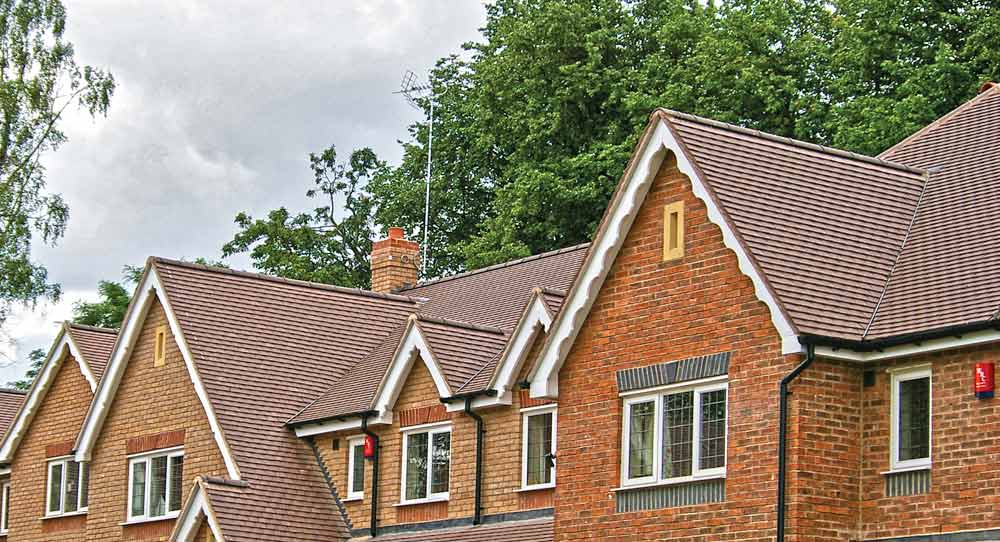
The move towards dry fix products has been accelerated by the large percentage of claims in relation to mortar and its potential to fail, even on new buildings. Mortar has a limited lifespan and requires maintenance as it will deteriorate in time through natural weathering. It is also susceptible to cracking because of the natural movement in the building structure and shrinkage. This can leave the ridge & hip tiles and verges vulnerable to the elements, which can then become dislodged by high winds and strong winds causing additional damage and water ingress and costly internal damage.
What is dry fix roofing and why adopt it?
Dry fix roofing is the method of mechanically fixing products and systems to the roof perimeter without the use of sand and cement mortar. The many advantages of dry-fix roofing highlight why it has been well established in Scotland for some time and now leading the way throughout the rest of the UK and Ireland.
- Simple and quick to install
- Can be installed in any weather
- Semi-skilled fitting procedure
- Mechanically fixed for secure installation
- Compliant with recent BS 5534 and NHBC requirements
BS 5534
As of September 2015, BS 5534:2014+A1:2015 Slating and tiling for pitched roofs and vertical cladding – Code of Practice was revised with the consideration of two main influences; an increase in extreme weather and the alignment of European standards.
The Standard has been developed in order to meet new regulatory requirements and design standards as part of changes to UK Building Regulations, European Eurocodes and industry Technical Standards. Whilst installing to the British Standard isn’t a requirement by law, it can be included with a specification and held up in a court if necessary.
The Code of Practice focuses on three main areas of changes, relating to;

- Fixing
- Mortar bedding
- Underlays
Focusing on mortar bedding, the standard states that mortar alone cannot be used and is insufficient to fix tiles and other fittings. Simply, this means that if mortar is used then additional materials are needed to create a mechanical fix.
Control of Lead at Work Regulations
IMPORTANT: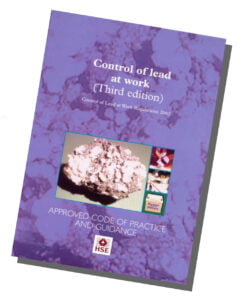
This Code of Practice has been approved by the Health and Safety Commision with the consent of the Secretary of State and gives practical advice on how to comply with the law. If you follow this advice you will be doing enough to comply with the law however alternative methods may still be used.
The Code has special legal status. If you are prosecuted for breach of health and safety law, and it is proved that the relevant provisions of the Code were not followed, you will need to show that you have complied with the law in some other way or a court will find you at fault.
The Regulations apply to any type of work activity which is liable to expose employees and any other person to lead as defined in Regulation 2, i.e. to:
(a) metallic lead, its alloys and all its compounds including lead alkyls; and
(b) lead when it is a component of any substance or material
Summary of the main changes:
In addition to certain definitions being inserted or amended;
Regulation 5 on assessment has been substantially revised to require that a suitable and sufficient assessment of the
risks created by working with lead is made and that steps taken to meet the requirements are made and implemented.
Regulation 6 has been substantially extended with a specific requirement to prevent exposure to lead by substituting a
substance or process which eliminates or reduces the risk to the health of employees.
A list of control measures for lead to be applied in order has been inserted.
A requirement to identify reasons and to take immediate steps when the occupational exposure for lead is exceeded has been added.
Regulation 8 now has new requirements inserted relating to the use of personal protective equipment.
Regulations 9 & 10 contain new requirements for the monitoring and recording of exposure and blood-lead concentration levels.
Regulation 11 on information, instruction and training has been extended.
Does this apply to roofing work?
Whilst lead has been used extensively for many years for all types of roof weather proofing, from flat roof and gutters through to flashings and soakers, the handling of lead can lead to ingestion particularly on small sites or jobs where adequate washing facilities are not readily available or used. Even smoking when working with lead increases the risk of exposure as lead contamination is transferred from the fingers, to the cigarette and then to the mouth. The risk is further increased with hand rolled cigarettes. When lead is welded and reaches temperatures of 500 C, it begins to fume and this can significantly increase the risk of exposure through inhalation.
What can I do about it?
A copy of ‘Control of lead at work’ can be obtained from HSE books and all of the requirements and regulations followed. In accordance with Regulation 6, there are now many alternative, cost effective roofing products and accessories available that can significantly reduce the amount of lead used and handled on site or even eliminate it altogether. Hambleside Danelaw is just one such company. Please do not hesitate to contacts us for details of our range of products.
Further Information
For help with queries regarding our products, get in touch with techelp@hambleside-danelaw.co.uk.
Why is there a need for roof ventilation?
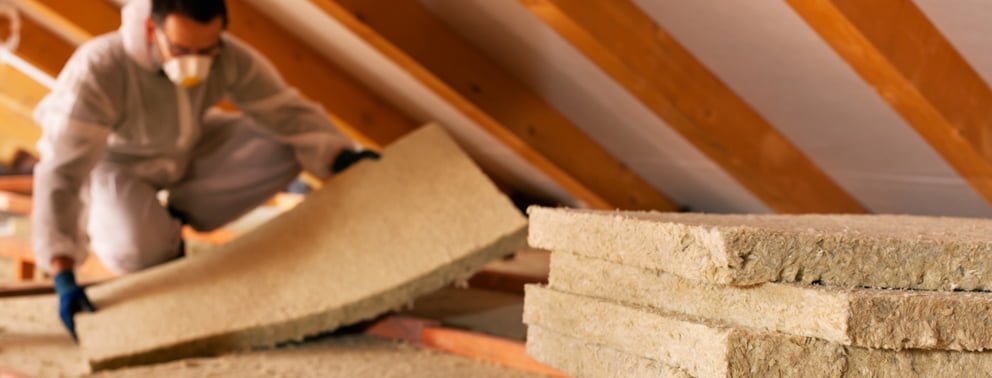
As modern construction techniques continue to place more emphasis on energy conservation, minimising the heat loss from buildings, insulation thicknesses have increased and air tightness is constantly improving. Although this is a way of achieving good energy performance certification, there is now far less opportunity for water vapour to be dissipated through fortuitous ventilation in the property, and therefore a higher chance of condensation build up and potential damage.
Few new buildings contain open fireplaces, single glazed windows and solid floor construction has become the norm. The increase in levels of moisture being created has gone hand in hand with more heating and greater insulation levels creating greater temperature differentials within the fabric of the building.
Water vapour in the air causes a vapour pressure, the warmer the air, the greater capacity there is to contain moisture. The greater the moisture content, the higher the vapour pressure becomes. This vapour pressure acts in all directions and will cause the water vapour to pass through the smallest of gaps to anywhere where the vapour pressure is lower until equilibrium is achieved.
Pitched, cold and warm roof ventilation
First of all, what type of construction is the roof? You may have heard of the terms cold roof and warm roof construction, but what do these actually mean?
In pitched roof construction, the insulation can be placed horizontally above the ceiling level forming a ‘cold roof’; it can be inclined above, between or below the rafters forming a ‘warm’ or ‘hybrid’ roof, or positioned in the roof structure in different ways where a ‘room-in-roof’ is to be created that can result in warm and cold roof construction types. Cold roof voids are generally always required to be ventilated; however, where vapour permeable (or Low Resistance, LR) underlays are specified, the levels required may be reduced. The enclosed void of a warm pitched roof may not require to be ventilated, but this is usually subject to the requirement to install a fully sealed Air and Vapour Control Layer (AVCL) in conjunction with an air-open roof covering.
Understanding the roof construction of any new build or refurbishment is essential to determine what products are required for the job.
Ventilation & Building Regulations
Approved Document C2 requires that roofs be designed and constructed so that their structural and thermal performance are not adversely affected by interstitial condensation. This requirement will be met if the roof is designed and constructed in accordance with Annex H of BS 5250 ‘Code of practice for control of condensation in buildings’ and BS EN ISO13788; ‘Hygrothermal performance of building components and building elements. Internal surface temperature to avoid critical surface humidity and interstitial condensation. Calculation methods.’ Further guidance is given in BRE Report BR262 ‘Thermal insulation: avoiding risks’.
To avoid excessive moisture transfer into roof voids, gaps and penetrations for pipes and electrical wiring should be filled and sealed, particularly in areas of high humidity such as kitchens and bathrooms and an effective draught seal should be provided to loft hatches to reduce the inflow of warm air and moisture. Vapour control layers can reduce the amount of vapour entering roof voids but cannot be relied on as an alternative to ventilation. A complete barrier to moisture is needed for this.
Scottish Technical Handbooks section 3.15 requires that dwellings shall be so constructed as to protect the building and its users, so far as may be reasonably practicable, from harmful effects caused by surface and interstitial condensation. Both these requirements are deemed to be satisfied by following the guidance given in BS 5250.
BS 5534; Slating and Tiling for Pitched Roofs and Vertical Cladding – Code of Practice recommends that roof ventilation be provided in accordance with BS 5250.
Roof Ventilation Installation
To provide ventilation, opening points can usually be provided on the following areas of a pitched roof:
- Roof surface
- Ridge line
- Eaves, soffits and fascias
For each of these areas, there are numerous products to suit different applications and construction details. They are also vital to meet the appropriate requirements and regulations by providing adequate ventilation levels into the roofs space. Our expansive range of ventilation products can deliver the ideal solution to these common issues.
Our independently tested flush fitting tile and slate vents provide some of the highest ventilation levels on the market in addition to being used for soil pipe ventilation and as terminals for mechanical extraction. Our universal dry fix ridge and hip system provides for full mechanical fixing of tiles while being compliant with BS 5534 and BS 5250.
For more information on the requirements for roofing ventilation, take a look at our Back to Basics articles.
Ventilation Ducts through Roof Spaces
 The following are some of the the recommendations contained in the Domestic Ventilation Compliance Guide – 2010 Edition (Amended July 2011) produced by the Department for Communities and Local Government, and apply to passive stack and mechanical ventilation & extraction systems.
Installation of Ducting
Rigid ducts should be used wherever possible. Where necessary, flexible ducts may be used, but their lengths should be kept to a minimum. The routing of ducts should minimise the overall duct length and minimise the number of bends required.
Ducting should be properly supported along its length to ensure that the duct can run straight without distortion or sagging and that there are no kinks at any bends or the connections to ceiling and outlet terminals. Flexible ducting should be fully extended and pulled taut to ensure that the full internal diameter is obtained and air flow resistance minimised. It should also be supported at suitable intervals, typically not exceeding 600mm, to minimise sagging.
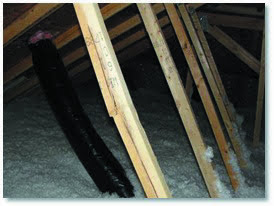 In the roof space the duct should be secured to a wooden strut that is securely fixed at both ends. A flexible duct should be allowed to curve gently at each end of the strut to attach to the ceiling terminal and roof outlet terminal.
Ducts should be securely fixed to the roof outlet terminal so that they cannot sag or become detached. Connection of lengths of flexible duct should not be taped only and must use a rigid connector and jubilee clips or similar to ensure a long term seal is achieved.
For extractor systems, ensure that the free area of the terminal opening is a minimum of 90% of the free area of the ducting being used. The location of the external discharge terminal should ensure that the potential for recirculation of extract air through any ventilation air inlets is minimised.
A tile ventilator may be used to terminate a passive stack ventilation system on the roof slope, but the terminal should be positioned no more than 0.5m from the ridge.
Ducting Insulation
All extractor ducting should be insulated where it passes through unheated areas and voids (e.g. loft spaces) with the equivalent of 25mm of material having a thermal conductivity of ˜0.04W/mK to reduce the possibility of condensation forming.
Condensation Traps
Horizontal ducting should be arranged to slope slightly downwards away from the extractor fan to prevent any backflow of moisture. Vertical ducting will require a condensation trap in order to prevent backflow of any Typical Condensation Trap moisture. Condensation traps are simple and inexpensive devices that are incorporated into the rigid pipework, but they do require a small diameter drain to the outside. These products can be readily found through appropriate distributors or via an internet search.
Soil Pipes
It is not usually recommended that soil pipes be insulated as they generally carry far less moisture than extractor pipes, however the connection to the rigid soil pipework should be adequate to ensure that any condensate does not leak at this connection.
Further Information
Take a look at our technical guidance for dry fix on our website, we also have a dedicated team to help with queries regarding our products, get in touch with them at techelp@hambleside-danelaw.co.uk.
Choosing The Right Roof Tile Underlay
The selection of roof tile underlay may be based on many considerations including ease of handling and forming the correct amount of drape, product weight, and wind zone suitability. Wind zone suitability still generates some misunderstanding and confusion as this is less straightforward than simply the geographical location.
Product Labelling
The key reference Standard for pitched roofing is BS 5534:2014+A2:2018 Slating and tiling for pitched roofs and vertical cladding. Code of practice. Section A.8 covers the zonal classification of underlays and includes an illustration of a zonal-classification label for a roofing underlay. This comprises of the wind uplift resistance values at different batten gauges and the wind zone suitability based on a limiting set of criteria such as the sealing level of the ceiling, ridge height, roof pitch, site altitude and site topography.
In some cases, the only information that is taken into account when selecting underlay is the geographical location in relation to the BRE (Digest 489) wind zone map. This, however, completely overlooks the limiting criteria which must be taken into account.
For example, Daventry – where Hambleside Danelaw is located – falls comfortably into wind zone 1 on the map. However, one of the limiting criteria of the BS 5534 labelling template is that site altitude should not exceed 100m. As Daventry sits above 100m metres above sea level, an underlay suitable only for zone 1 may not be suitable, and one that might be suitable for zone 3 or even zone 4 may be required.
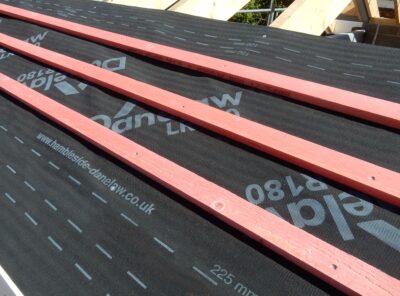 Wind Uplift Resistance
For all new build work, the tile fixing specification should state the determined peak velocity wind pressure that should be used to determine the suitability of the underlay. Hambleside Danelaw’s LR180 for example, can be used in wind zones 1 to 4 and has a wind uplift resistance of 1378 Pa with tile battens spaced at 345mm and batten lap restraint. This value increases as the batten gauge reduces. Lighter weight underlay products with laps that are sealed with a tape can often exceed this level of wind uplift resistance, particularly when using an integral tape-to-tape system such as the Danelaw LR120TT option.
All of Hambleside Danelaw’s Low Resistance (LR) Underlays carry labels that declare the tested wind uplift resistance, independently verified by BRE, which can be compared to the peak wind uplift load as stated in the fixing specifications.
In some cases, such as re-roofing or roof alterations, there may be no wind load resistance figures available; it then becomes prudent to err on the side of caution and select a product that is more likely to exceed the wind uplift resistance required than one that is inadequate.
One of the methods that can be followed is by engaging an independent technical assessor or roofing underlay manufacturer, who will be able to advise on a more project specific basis.
Selecting the Right Product
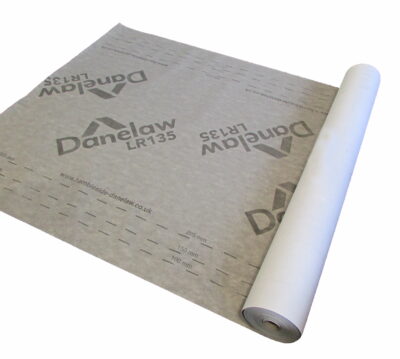 Underlay roll labels should have the wind zone use shown clearly along with the wind uplift values for different batten gauges and any limiting criteria.
Underlays backed by third-party accreditation, such as BBA certification, provide reassurance of a consistency of product quality and fitness for purpose to suit the actual applications required.
Hambleside Danelaw’s range of LR roofing underlays are BBA certified demonstrating that manufacturing process is audited regularly to ensure consistency of quality and performance.
Find Out More
To learn more about Hambleside Danelaw’s range of LR underlays, get in touch via our contact page.
Hambleside Danelaw also offer a CPD course: Understanding the Function and Selection of Roof Tile Underlays, which can be booked online.
